Race day needs restrooms staged along the whole route, not clustered at the start line. For a 5,000-runner marathon, plan on one standard unit per 200 to 250 participants at mile stations, plus banked units at start and finish. Hialeah Porta Pros builds the layout around your course map, aid stations and expected crowd size.
Course length and runner count drive the count more than anything else. OSHA 1926.51(c) sets construction ratios at one toilet per 20 workers, and while a race isn't a job site, event planners use similar per-person math scaled to spectator density. A 5K through a Hialeah neighborhood might need six to eight standard porta potty rental units at the finish festival alone, while a full marathon spanning several miles needs restrooms at every aid station, roughly every 2 to 3 miles.
Spectator zones matter too. Family areas near the finish draw crowds that sit for hours, so event restroom rental planning should treat that area like its own small festival. If your race pulls runners from Miami Lakes 3.9 miles north or Miami Springs 4.9 miles south, expect vehicles staging nearby, and plan restroom clusters where cars park, not just where runners pass. We also stock ADA accessible porta potty units, and ADA Standards section 213.2 requires at least 5 percent of a clustered bank, and never fewer than one, to be accessible. A 60 inch turning circle inside those units follows ADA Standards section 304.3.1, and the door clears at 32 inches per ADA Standards section 404.2.3. For races that route near Opa-locka, 4.6 miles northeast, or Westview, 4.7 miles east, we've mapped drive times and staging points already through our service areas coverage.
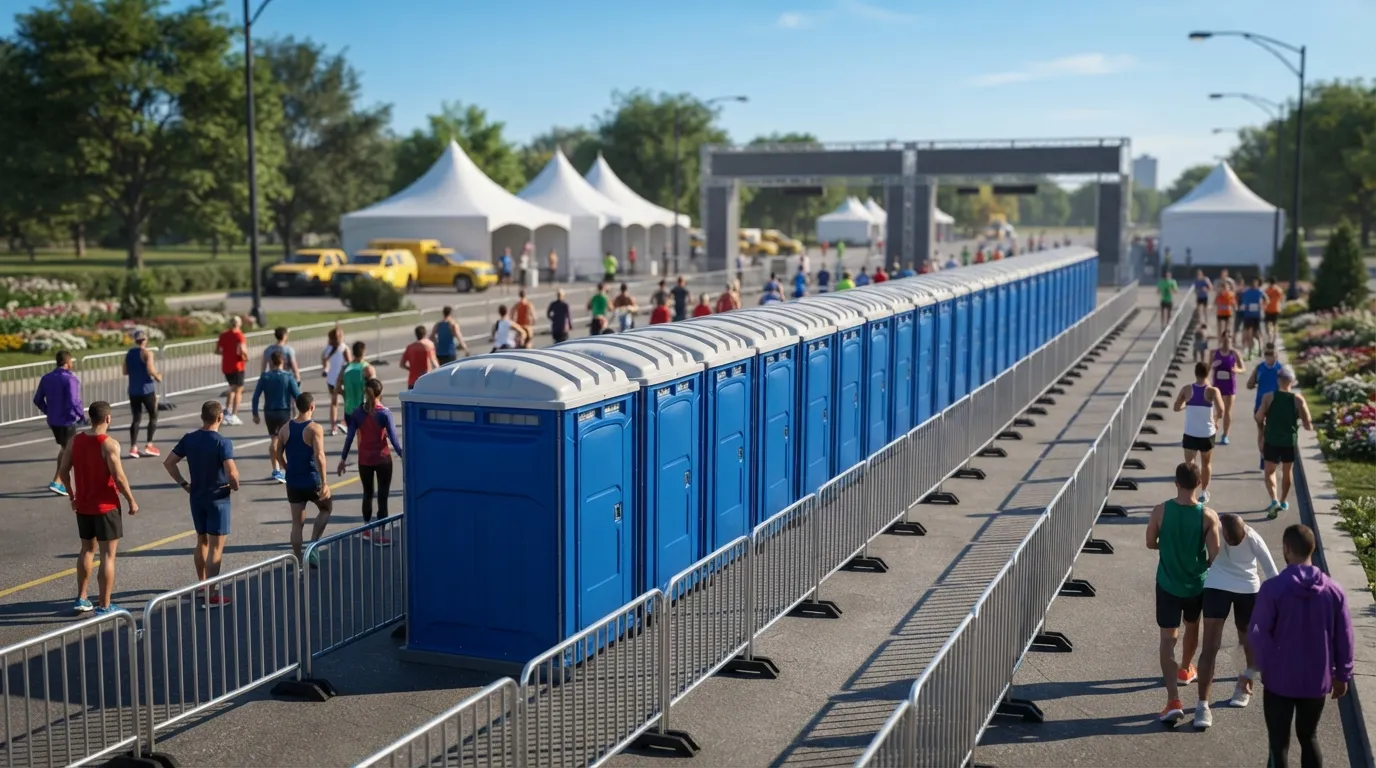
Every restroom on a route sits somewhere pedestrians, volunteers and vehicles all cross, so placement takes real planning. Follow the same logic as our porta potty placement guide: firm, level ground, a path wide enough for our service truck, and enough clearance that servicing during the race doesn't block runners. ADA Standards section 302.1 requires stable, slip-resistant surfaces, and a 36 inch clear route per ADA Standards section 403.5.1 matters just as much on grass or gravel as on pavement.
Timing tables and finish-line lighting often run off a generator or a temporary power pole, and if your race extends into early morning or evening, a light tower helps volunteers and stragglers see the course. Ground crews should know how to brace a temporary power pole against wind and foot traffic before race morning, since a pole that shifts mid-event can drop timing equipment or lighting right when you need it most. Keep guy wires taut, anchor the base plate on solid ground, and route cables away from runner lanes. If your event runs near West Little River, 5.2 miles east, or crosses into Hialeah Gardens territory 5.4 miles west, confirm placement of any right-of-way equipment with the city before setup, since permit rules for street closures and staging aren't something we can quote without checking first with Hialeah directly.
Barricades along the route should conform to ANSI D6.1 under OSHA 1926.202, which is the same standard our crews reference when we stage temporary fence rental or crowd control barrier rental sections near restroom clusters and aid stations.
Race-day rentals run on an event pricing structure, not a flat daily rate, because setup, servicing mid-race and teardown all factor in.
| Unit | Day | Weekend | Event |
|---|---|---|---|
| Standard unit | $100 to $350 | $125 to $400 | $200 to $800 |
| ADA unit | $200 to $400 | $199 to $300 | -- |
| Restroom trailer | $175 to $2,500 | $900 to $3,000 | $2,499 to $3,899 |
Larger races with VIP tents or sponsor areas often add a luxury restroom trailer or a 4 stall restroom trailer near the finish line, and a full breakdown of trailer economics lives on our restroom trailer rental cost page. Delivery fees for scattered course locations vary with distance and unit count, so request a quote once your route map is set. For hand cleaning stations at aid tables, ANSI/PSAI Z4.3 sets a baseline service interval, and 29 CFR 1910.141(d)(2) requires soap and towels, not sanitizer alone, at any handwashing station rental you add along the course.
Book 60 to 90 days out for anything over 1,000 runners. Course permits, street closures and vendor logistics all compete for the same lead time, so early booking secures unit counts before other Hialeah events lock in the same week.
Yes. Our trucks stage units at each aid station or checkpoint on your route, coordinated around road closures and volunteer schedules. Multi-point delivery works like our construction site services logistics, just spread across miles instead of one job site.
At least one accessible unit per cluster, per ADA Standards section 213.2. Races drawing wheelchair participants or handcycle divisions need accessible units at the start, finish and major aid stations, not just one token unit somewhere on the course.
Units get serviced and secured regardless of weather. See our porta potty in winter guide for cold-weather notes, though Hialeah races deal with heat and downpours more than freezing conditions.
Start with our how many porta potties do I need guide, then call us with your runner count and course map so we can place units where crowds actually gather, not just at mile markers.
Yes. Hialeah Porta Pros delivers marathon and race restrooms across Hialeah and the surrounding metro, with same-day and next-day drop-off available on most orders.
Pricing depends on the unit and how long you need it. See our cost breakdown and request a free quote for an exact figure.
Standard rentals include scheduled service — a pump-out, a clean, a restock and fresh deodorizer. Busy or hot-weather sites can be serviced more often.
Call now or request a free quote — clean units, on-time delivery, transparent pricing.